What should I include in a grant reimbursement request?
A reimbursement request asks the funder to pay back costs you have already paid. The ones that get paid without questions tie every dollar to a budget line, a date inside the award period and a document. Here is a checklist for building one, and what 2 CFR 200.305 says about payment timing for federal awards.
The method
- Read how the agreement pays you. Search for "payment", "reimbursement", "advance", "draw" and "invoice". Note whether you are paid by reimbursement, in advance or by milestone, how often you may request, which form or portal the funder uses and the deadline for the last request. As read on 2026-10-26, 200.305(b) generally allows advance payments when recipients meet its conditions and prefers reimbursement in listed cases, but your agreement decides which applies to you.
- Fix the period and the budget lines. Write down the dates the request covers and the approved budget by line. Costs outside the award period or the approved lines will be questioned; if you moved money between lines, make sure you have the approval. See how to ask a funder to change your grant budget.
- Pull the ledger for this award only. Run the transaction report for the award's class, fund or project code for the period. Reconcile its total to the general ledger so you are not requesting costs that were reclassified.
- Attach backup to every cost. For each line: the vendor invoice, proof you paid it (check, ACH or card statement line) and who approved it. For payroll, the payroll register and the time records that support the percentage charged. See how to document staff time on a grant. For travel, the receipts and the purpose.
- Test each cost against the award. Ask four questions: is it in the approved budget, does the agreement or cost rules allow it, is the date inside the period and has it been charged to any other award. Anything doubtful gets left out or raised with the funder before the request.
- Total by budget line and compare to the balance. Show the approved budget, spent to date, this request and the balance remaining for each line. A request that pushes a line over its budget needs an approved change first.
- Use the funder's form. As read, 200.305(b) says the federal agency must require recipients to use only OMB-approved, government-wide information collections to request payment, except as noted in the part. In practice, use the form or portal the agency or pass-through entity gave you and fill in every field.
- Get a second person to check the arithmetic, then the authorized person signs. The preparer, a reviewer and the authorized signer should be three roles even if two are the same person on a small team. A reviewer catches the transposed digit before the funder does.
- Send it the funder's way and keep the proof. Portal, email or mail. Save the confirmation, the date sent and a copy of exactly what went.
- Put the expected payment date on the calendar. As read, 200.305(b)(3) says that when the reimbursement method is used, the federal agency or pass-through entity must pay within 30 calendar days after receipt of the request unless it reasonably believes the request to be improper. Other funders set their own timing. If the date passes, follow up in writing.
- Record the payment and reconcile it. Match the deposit to the request, note the date, and file the request, the backup, the confirmation and the payment together.
Your award agreement and your funder's instructions are the authority on every date and requirement. This page is a working method, not legal, audit or compliance advice.
A worked example (made-up award)
A $90,000 award is reimbursed quarterly. For the second quarter the request shows each budget line with what was spent before, what this request claims and what is left:
| Budget line | Approved | Paid in earlier requests | This request | Balance left |
|---|---|---|---|---|
| Personnel | $60,000 | $15,000 | $14,500 | $30,500 |
| Supplies | $12,000 | $2,000 | $3,100 | $6,900 |
| Training | $18,000 | $0 | $4,200 | $13,800 |
| Total | $90,000 | $17,000 | $21,800 | $51,200 |
Each row of $21,800 has an invoice, proof of payment and an approver behind it, and the payroll line has the time records. A second person confirms each balance equals approved minus earlier minus this request. The request goes in through the funder's portal on the 12th, the confirmation is saved, and 30 days later is on the calendar.
If your award pays in advance instead
The checklist still applies, since you will need the same records when you report what you spent. As read, 200.305(b)(5) says that if available, a recipient must disburse funds from program income, rebates, refunds, contract settlements, audit recoveries and interest earned on federal funds before requesting additional cash payments. Ask your finance lead whether any of those exist before each draw.
Common mistakes
- Requesting a cost that has not been paid. A reimbursement is for money already spent.
- No backup for a small cost. Reviewers sample; the one you skipped is the one they pick.
- Payroll with no time records. The percentage needs support.
- Exceeding a budget line. Get the approved change first.
- No follow-up date. A request nobody is watching is how a 30-day payment becomes 90.
The faster path, and what it does not do
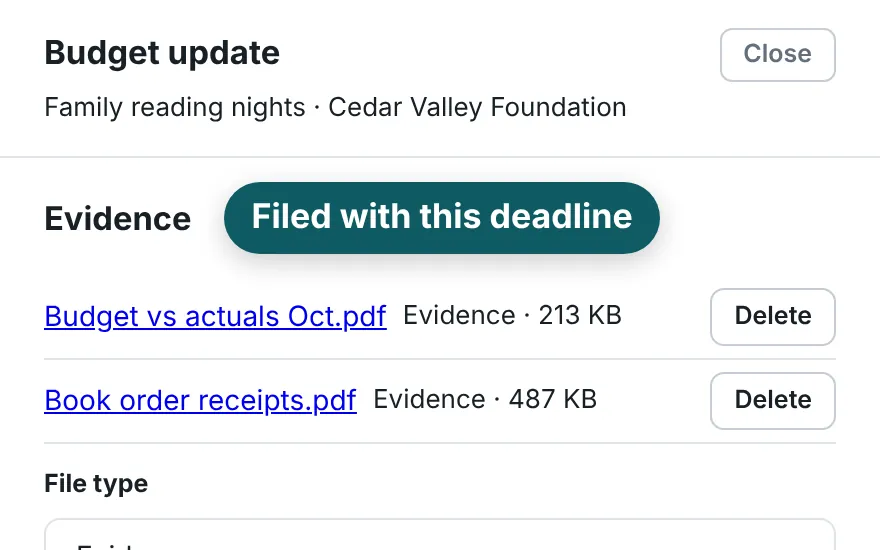
GrantClose does not prepare the request, total costs, connect to your accounting system or log in to a funder portal. What it can do is keep the routine from slipping. Add "reimbursement request" as a recurring deliverable on the award with one owner, a due date and reminders at 30, 14, 7 and 1 days before and on the due date. When the owner marks it submitted, GrantClose records how it was sent (funder portal, email, mail or other) and the date, and the request, the backup packet and the confirmation can be attached as evidence. Add a second deliverable, "payment received", with the follow-up date you choose. At closeout you can export a ZIP per award with an index and a SHA-256 checksum per file.
- It does not submit anything to a funder; your team sends the request and records it.
- It does not calculate amounts or check them against the budget.
- It holds only what you upload, up to 15 MB per file.
GrantClose gives every recurring grant task one owner and a reminder schedule, and keeps the evidence beside it. It does not prepare payment requests, submit anything to a funder or give legal, audit or compliance advice. Free for 1 active award, 1 seat and 250 MB of files. Create a free account
Questions
What is a grant reimbursement request?
A request asking the funder to pay back costs you already paid for the award, usually with a form or portal entry and backup for each cost. Your agreement says how often you may send one.
What documents do I need to attach?
For each cost, the invoice or receipt, proof of payment and approval; for payroll, the register and the time records. Use the funder's form for the request itself.
How long does the funder have to pay?
It depends on the funder. For federal awards paid by reimbursement, 2 CFR 200.305(b)(3), as read on 2026-10-26, says payment must be made within 30 calendar days after receipt unless the agency or pass-through entity reasonably believes the request to be improper.
Can a funder hold my payment?
As read, 200.305(b)(6) says payments for allowable costs must not be withheld during the period of performance unless required by federal statute or regulation, or the recipient has failed to comply with the award terms, or is delinquent on a federal debt. Foundations and states follow their own agreements.
How often can I submit a request?
As often as the agreement allows. Federal text, as read, lets recipients submit payment requests as often as necessary when electronic fund transfers are used, or at least monthly when they are not, but your agreement sets the schedule.
Sources read
- 2 CFR 200.305 (Cornell LII copy of the eCFR), read on 2026-10-26 from the eCFR.
- 2 CFR 200.308 (Cornell LII copy of the eCFR), read on 2026-10-26 from the eCFR.