What is a grant deliverable, and how do you list every one in your award?
A grant deliverable is anything the funder's agreement says you must produce, submit, show or keep by a date. Reports are the obvious ones. The ones that get missed are the certificates, notices, data uploads and counts buried in the terms. Here is how to list them all.
The method
- Use this test for each sentence in the agreement. Does it name a thing you must hand over, or a number you must reach, and a time? "Submit a mid-year report by 15 January" passes. "We value community partnerships" does not. Only the first kind is a deliverable.
- Read the whole agreement, not just the reporting section. Deliverables sit in the narrative, the budget, the special conditions, the attachments and the portal instructions. Search for "must", "shall", "submit", "provide", "notify", "no later than" and "within".
- Sort what you find into types. Reports (financial and programmatic), outputs (a count of people served or a product delivered), notices (tell the funder before a key staff change or budget move), certificates and proofs (insurance, registration, audit), data uploads, and events (a site visit or a convening). Each type has different evidence.
- Write one row per deliverable with five fields. What it is, the due date or the rule that produces it, one named owner, its status, and the evidence that it was done. If the date is a rule such as 30 days after quarter end, write the rule and the first computed date.
- Keep outputs separate from outcomes and activities. An activity is what you do (run twelve workshops). An output is a countable result you report (120 attendees). An outcome is the change you hope for (more people employed). Funders usually require outputs and sometimes outcomes; only list what the agreement actually requires you to report.
- Mark what is conditional. "Notify us if the project lead changes" is a deliverable that may never fire. Put it on the list with its trigger, so someone knows it exists.
- Confirm the list against the agreement once more. Read it top to bottom with the list beside it. Anything you cannot find a row for is an unlisted deliverable. Anything on the list that you cannot find a sentence for should come off.
Your award agreement and your funder's instructions are the authority on every date and requirement. This page is a working method, not legal, audit or compliance advice. For federal awards, the reports a recipient owes are covered by 2 CFR 200.328 and 2 CFR 200.329.
Examples across the common types
| Type | Example (made-up wording) | Evidence to keep |
|---|---|---|
| Financial report | Quarterly expenditure report, due 30 days after quarter end | The submitted report and the portal or email confirmation |
| Programmatic report | Annual narrative report on activities and results | The submitted file, confirmation, and the data behind the numbers |
| Output | Serve at least 100 households by the end of the award period | The count with its source list or system export |
| Notice | Tell the funder in writing before changing the project lead | The notice and the funder's reply |
| Certificate or proof | Provide a current certificate of insurance at signing and renewal | The certificate with its expiry date |
| Data upload | Enter participant data into the funder's system monthly | An export or screenshot of the upload confirmation |
| Event | Host one site visit during the second year | The agenda, attendee list and any follow-up |
A worked example (made-up award)
A one-year award letter has a reporting section listing a mid-year and a final report. Reading the whole agreement also turns up: a certificate of insurance at signing, a notice requirement for any budget move over 10 percent, a monthly data upload, and a count of 100 households served. The reporting section showed two deliverables; the agreement contains six rows, plus one conditional. The data upload is the one nobody would have noticed until it was three months late.
Common mistakes
- Counting only the reports. The deliverables outside the reporting section are the ones that lapse.
- No owner. A row owned by "the team" is owned by nobody. One person, named.
- Listing goals as deliverables. If the agreement does not require you to report it, it is a goal.
- No evidence column. At closeout you want the proof beside the row, not in someone's inbox.
The faster path, and what it does not do
In GrantClose a deliverable is the unit of work: it has a due date, one owner, a status and its evidence. You upload the award letter, it suggests the reporting dates it finds in the text, and nothing becomes a deliverable until you click to confirm it. Status runs from not started to in progress to submitted to accepted, or waived at any point. The free calculator on this site does the date arithmetic for the six recurrence rules with no signup.
- Extraction reads text-layer PDFs and Word files with fixed rules. It is not AI and it does not read scans; a file with no text layer opens manual entry instead.
- GrantClose finds reporting dates. It will not find a notice obligation or a certificate expiry written in prose, so you still read the agreement.
- GrantClose never submits anything to a funder or writes your reports.
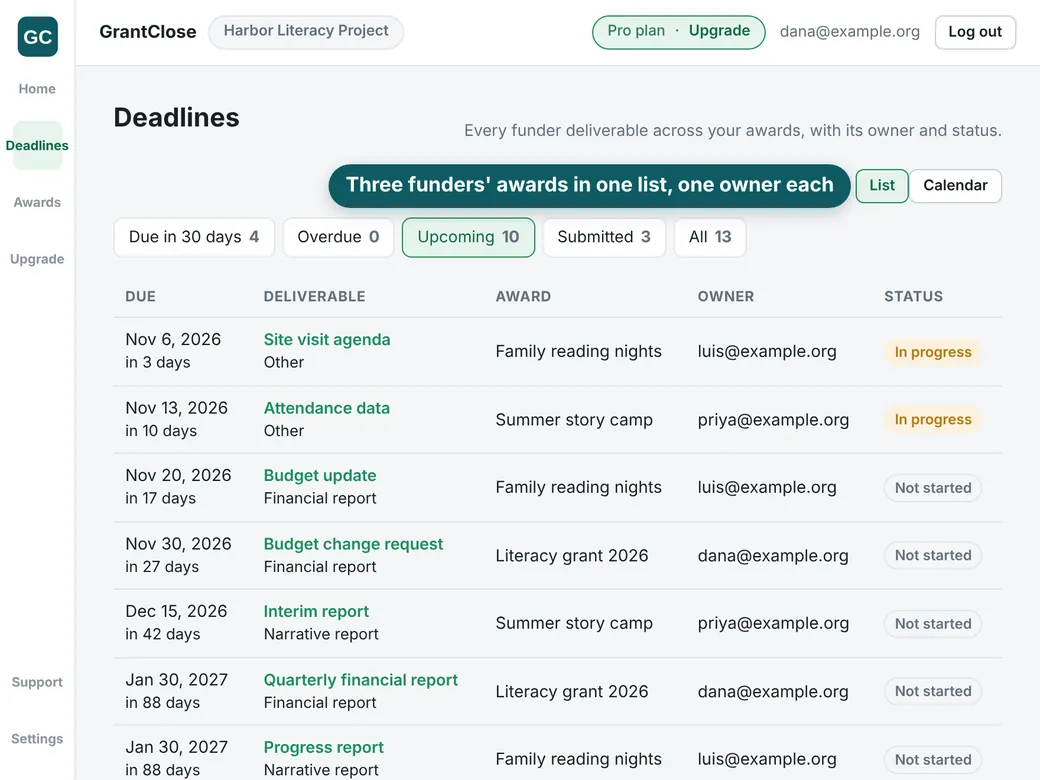
GrantClose turns a confirmed award letter into deliverables with owners, reminders and evidence. GrantClose never submits anything to a funder, writes your reports or gives legal, audit or compliance advice. Extracted dates are suggestions you confirm. Free for 1 active award. Create a free account
Questions
What is a grant deliverable?
Anything the funder's agreement says you must produce, submit, show or keep by a date, such as a report, a count of people served, a certificate or a notice.
Is a grant deliverable the same as a report?
No. Reports are one type. Outputs, notices, certificates, data uploads and events can all be deliverables if the agreement requires them.
What is the difference between a deliverable and an outcome?
A deliverable is something the agreement requires you to hand over or reach. An outcome is the change you hope the work produces. Only some outcomes are required to be reported; check the agreement.
Where do I find all the deliverables in an award?
Read the whole agreement, including the narrative, budget, special conditions, attachments and portal instructions, and search for words such as must, shall, submit, notify and within.